How to Make Masala Chai
Also known as: chai recipe, spiced tea
What this guide solves
Real masala chai: water and milk boiled together with crushed ginger and green cardamom, then strong CTC tea and sugar — the two-essential-spice version that street stalls and home kitchens actually make, not tea-bag-in-warm-milk.
Where it goes wrong
Tea-bag-in-milk 'chai' is a different drink — no spice extraction, no real boil, no body. Proper chai is boiled hard with the spices in from the start, and the usual shortcuts (steeping instead of boiling, long-leaf tea instead of granular, powder instead of crushed fresh ginger) each produce something that looks like chai and tastes like sweet milk. The other half of the problem is the pan. Chai is made at a hard boil, in a vessel deep enough to hold the foam, and it needs attention for the three or four minutes it is on the heat, because the moment the milk starts to climb it climbs fast. A chai left to itself is a burnt pan and a kitchen that smells of it for a day. Strength is the last confusion. It comes from the ratio of tea to liquid and from the violence of the boil, not from time.
The method
- 1. Water and milk, roughly 1:1 — In the pan together from the start. The water fraction is what lets tea and spice extract before the milk coats everything. A one-to-one ratio by volume gives a thick, strong chai; more water makes it lighter, more milk sweeter and heavier.
- 2. Crush fresh ginger and green cardamom — A thumb of ginger, smashed or grated, and three or four pods cracked with the flat of a knife. These two are the essentials; cinnamon and clove are optional extras, not requirements. Crushing matters more than quantity — a whole pod barely infuses, a cracked one gives up its oils in seconds.
- 3. Use strong CTC-style loose tea — The granular dark kind, not long-leaf. CTC gives colour and bite that survive milk; long-leaf brews thin and perfumey here. A heaped teaspoon per cup. Look for a dark, faintly oily granule — that oil is the tea's own, and it is part of what makes the drink feel thick.
- 4. Boil the spices 2–3 minutes before the tea goes in — The spices need the head start — ginger in particular releases its warmth only with a genuine boil. Bring water, milk and spices to a boil and hold it there; the surface should be moving all over, not merely trembling.
- 5. Add tea and sugar, simmer 2 minutes — Sugar during the boil, not after, so it thins into the drink instead of sitting in it. Two minutes at a rolling boil is enough for CTC; past three the tannin takes over.
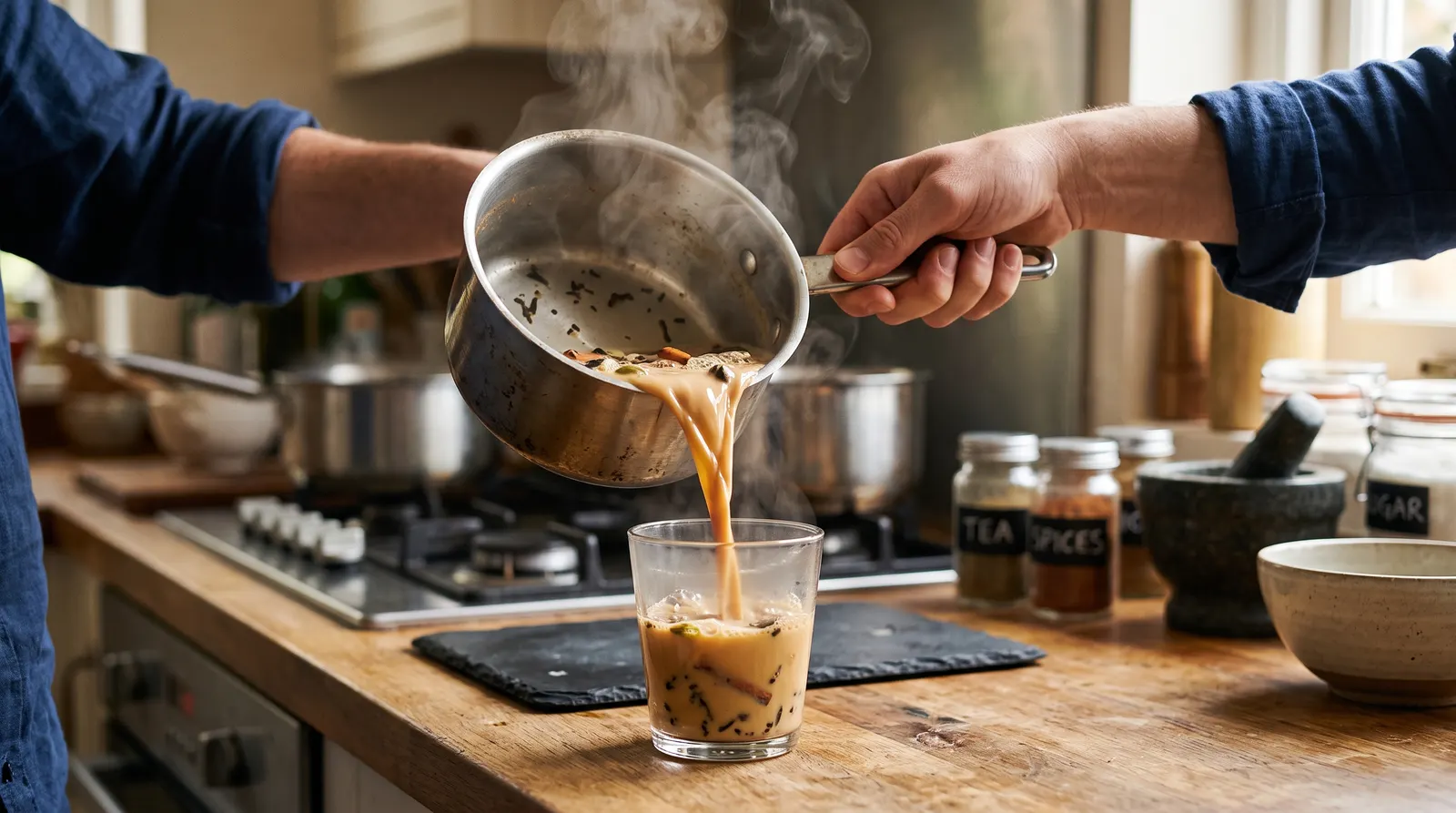
- 6. Strain into the cup from height — A steady pour from 20–30cm froths and aerates the chai at once. That foam is the finish. Hold the strainer high and pour in one movement rather than dribbling it in.
Pro tips
- A few fennel seeds crushed in with the cardamom give the sweeter, more perfumed version many stalls pour.
- Japanese supermarket milk is excellent for chai but runs lighter than Indian full-fat — shift toward 40:60 water to milk for a richer cup.
- If the pan starts to climb, lift it off the heat rather than turning the gas down; the foam collapses as soon as the heat stops and the chai is fine.
- Rinse the pan with hot water as soon as it is empty. Cold water on a hot milk pan leaves a skin that takes a soak to remove.
- The chai is ready when it coats the strainer and pours in a continuous rope rather than in drops. If it runs thin, it needed another thirty seconds.
Why it works
Tea is extracted in two stages. Colour, caffeine and tannins come out quickly into hot water; the aroma compounds come out more slowly and are easily driven off by heat. Milk changes both. Its fat dissolves aromatic compounds that water cannot hold, which is why chai tastes of cardamom in a way a cardamom infusion in water does not, and its proteins bind some of the tannins, which is why a chai boiled with milk is rounder than tea brewed in water and then diluted. The boil does two things at once. It keeps the liquid moving, so fresh liquid keeps reaching the tea and the spice surfaces instead of sitting in a still boundary layer, and it holds the temperature at the top of the range where the oils are released. It also destroys aroma, which is why chai boils for minutes rather than for a quarter of an hour. CTC tea is milled into granules rather than rolled into leaves, so a given weight has far more surface area and gives up its colour and strength in about two minutes. That is the exchange the drink is built on: fast, strong extraction, then milk and sugar to carry it. The frothing at the end is mechanical rather than chemical — the pour folds air into the liquid, and the foam holds the aroma at the surface, where you smell it first.
If it went wrong
- The tea is steeped rather than boiled, and the result is pale, thin and sweet. — Boil it: steeping gives tea-flavoured milk with no body to it.
- The pan is too small, the chai boils over, and the stove is covered. — Use a pan at least twice the volume of the liquid, so the foam has room to rise.
- It is boiled for ten minutes to make it stronger, and comes out bitter and stewed. — Past about three minutes the tannins keep coming and the aromatics have gone. Use more tea, or less milk, for a stronger cup.