Masala Chai
Tea boiled with milk, sugar and whole spices — not tea with milk added.
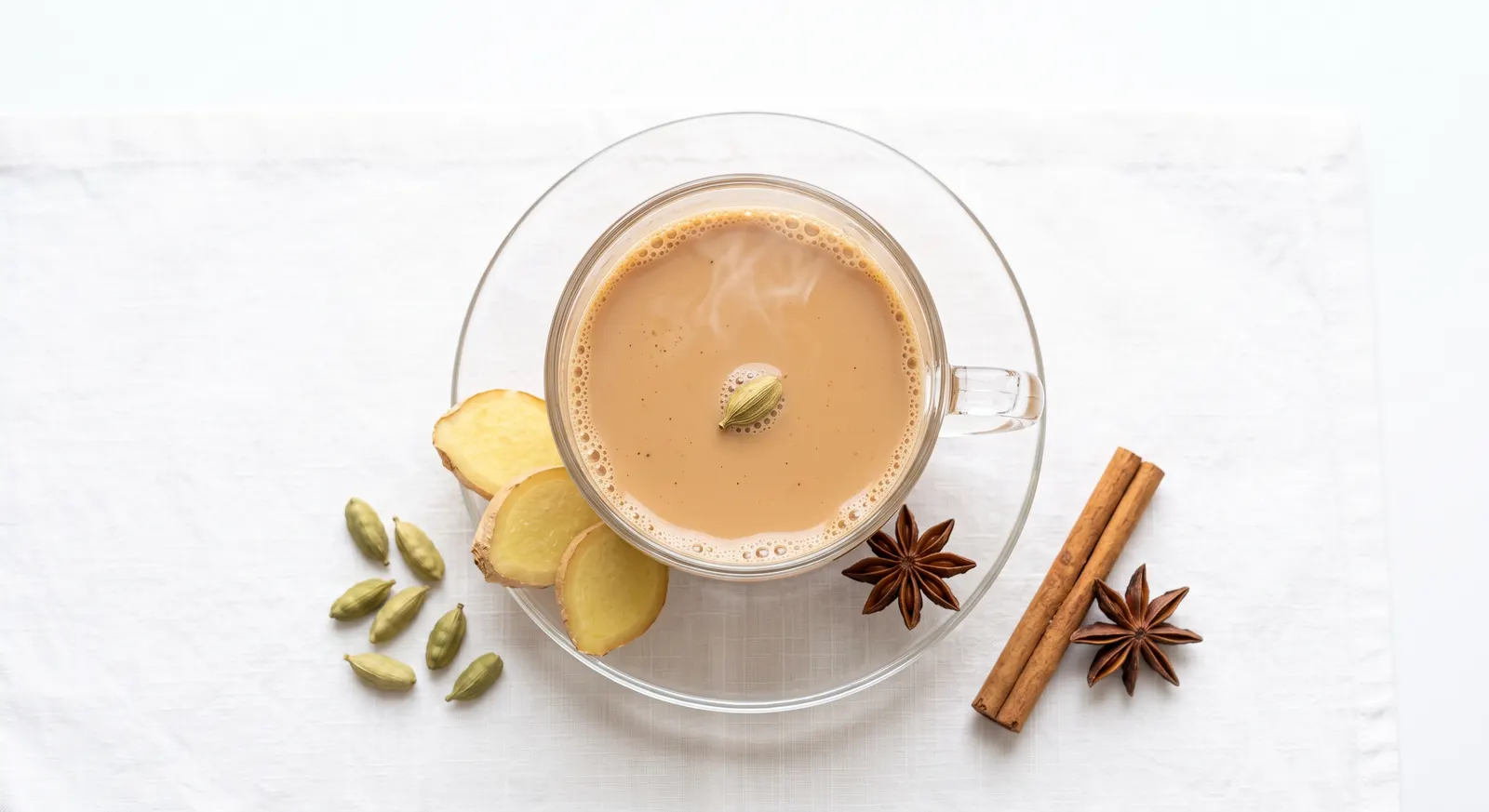
- Prep
- 5 min
- Cook
- 12 min
- Total
- 17 min
- Serves
- 2
- Heat
- Not spicy
What Masala Chai is
Masala chai is made by boiling tea leaves, milk, sugar and crushed spices together, rather than brewing tea and adding milk afterwards. The result is strong, sweet and thick enough to coat the cup.
Where it comes from
Tea was grown in Assam for export long before most Indians drank it; the domestic habit was built in the early twentieth century, and cooks adapted it by boiling it with milk and the spices already in the kitchen. Every family and every roadside stall has its own ratio, and the argument about whether ginger or cardamom should lead is genuinely regional. Masala simply means a mixture of spices, so there is no fixed formula, and a stall's blend is its signature. The milk and sugar did as much for the drink's spread as the spice did: they made a small quantity of leaf go further and turned it into something filling enough to sell beside fried snacks.
How to eat it
Drink it hot and fairly quickly — chai is not a drink to nurse, and it is taken at any hour, usually with something fried or a biscuit, and is offered to any visitor almost automatically. If you want it less sweet, say so before it is made: the sugar is boiled in, not added at the table. In Nepal the equivalent is chiya.
Goes well with
- Samosa or pakora
- Biscuits for dunking
- Anything fried and salty
How it varies
Chai changes by town and by stall. Mumbai's cutting chai is a small, strong, very sweet glass filled halfway; Kolkata's doodh cha is milk boiled with tea and sugar, with little or no water; in Assam, where the tea is grown, gakhir saah is milk tea and ronga saah is the same leaf drunk black. Kashmir's noon chai is pink and salted, coloured by baking soda during a long boil, and has little in common with the sweet spiced version. Pakistani doodh patti goes further and boils the tea in milk alone, without water, which makes a thick, caramel-coloured drink. In Nepal, chiya usually leads with ginger rather than cardamom. The spice mix varies as much as the tea: some houses use only ginger and cardamom, others add fennel, star anise, nutmeg or a pinch of black salt, and many keep a jar of ground chai masala to spoon in. Leaf grade matters more than most people admit — CTC granules are the small crushed pellets used in most Indian blends, whereas whole orthodox leaf is better brewed and drunk without milk. A café chai latte is a different drink again: a spiced concentrate diluted with steamed milk, much milkier and usually sweeter than anything boiled at a stall.
After the meal
Chai does not keep. The leaves carry on extracting after the pot comes off the heat, so a standing cup turns bitter and astringent within twenty minutes. Reheating only concentrates that: the milk proteins coagulate, the tea goes metallic, and the ginger and cardamom — the most volatile part of the drink — have already gone. The practical answer is to make only what will be drunk, or to keep the two halves apart: boil the water, tea and spices at double strength, strain the concentrate into a jar, keep it three or four days in the fridge, and add hot milk and sugar to order. A skin forming as it cools is not spoilage, it is milk protein and fat setting at the surface, and it can be lifted off. Leftover chai is better chilled and drunk over ice the same day than reheated, and a spoon of it can go into a cake or a bread dough for colour and spice.
Ingredients
- 250 ml Water
- 250 ml Full-fat milk — Full fat; low-fat chai tastes thin.
- 2 tsp Strong black tea, preferably CTC Assam — CTC grain stands up to boiling; delicate leaf turns bitter.
- 2 cm piece Fresh ginger, crushed
- 4 pods Green cardamom, crushed
- 1 small piece Cinnamon stick
- 2 Cloves
- 2 Black peppercorns — Optional; common in winter and in Nepali chiya.
- 2 to 3 tsp Sugar
Spices in this dish
How to cook it
1Crush the whole spices coarsely
Bruise the cardamom, cinnamon, cloves and pepper in a mortar. Ground spice powder makes the chai muddy and slightly gritty; coarse pieces release flavour cleanly and strain out.
2Boil the spices in water first
Bring the water, crushed spices and ginger to a boil and let them go for three or four minutes before anything else joins them. Spices need water and time; added later with the milk they never fully infuse.
3Add the tea and boil hard
Add the tea leaves and boil for two minutes until the liquid is very dark. This is deliberate over-extraction — the milk will dilute it back.
4Add milk and sugar, then bring it up three times
Pour in the milk and sugar and bring it to the point of rising up the pan, pull it off, and let it settle. Repeat twice more. Each rise thickens the chai; a single boil gives a thinner drink.
5Pull it to aerate
Pour it between two vessels from a height a few times. This cools it to drinking temperature and gives the light foam on top that a stall chai always has.
6Strain into small cups
Strain and serve in small glasses or cups. Chai is drunk in modest quantities, hot, and refilled — not in a mug. At stalls in north India the cup is often an unglazed clay kulhad, thrown away after use.
Calories and nutrition
Per serving — 1 cup (about 220 ml)
| Calories | 130 kcal |
|---|---|
| Protein | 4 g |
| Carbohydrate | 18 g |
| Fat | 4 g |
| Fibre | 0 g |
| Sodium | 55 mg |
Approximate values for a typical restaurant portion, calculated from standard ingredient tables. Actual figures vary with the kitchen, the oil used and the portion served. Not intended as medical or dietary advice.