Cucumber Raita
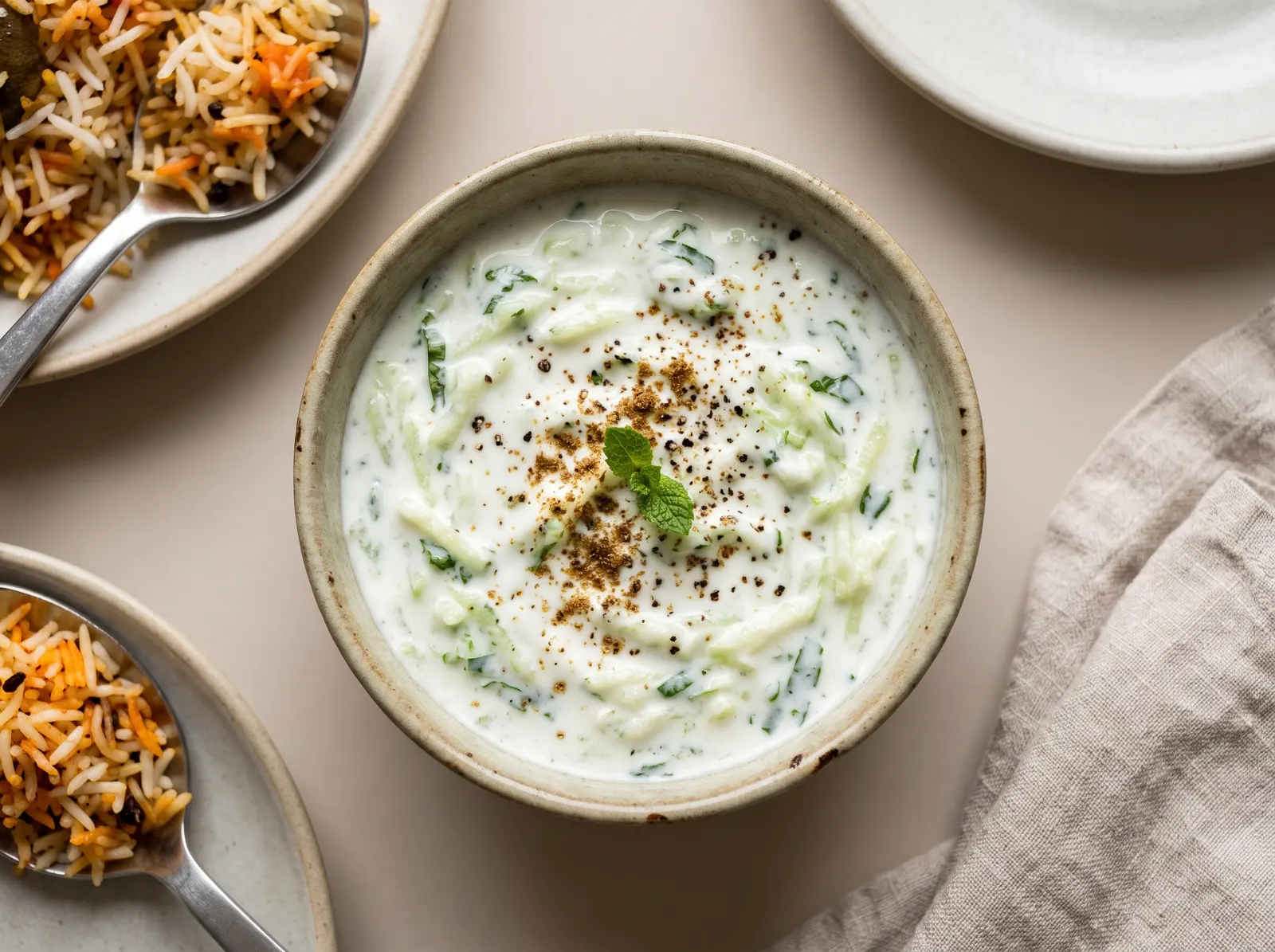
Cold yoghurt with grated cucumber, mint and roasted cumin — the cooling side to spicy food.
- Prep
- 15 min
- Cook
- 5 min
- Total
- 20 min
- Serves
- 4
- Heat
- Not spicy
What Cucumber Raita is
Raita is a thin, cold yoghurt side, here made with grated cucumber, fresh mint and cumin that is toasted and ground at home. It is lightly salted and kept loose enough to spoon over rice or eat with bread. On the table its job is to cool the heat of the main dishes rather than compete with them.
Where it comes from
Raita is a yoghurt dish of the Indian subcontinent, and the word is usually traced to Hindi and Urdu roots that go back to Sanskrit terms for black mustard and something sharp. It is eaten across India, Pakistan and Bangladesh, and the vegetable version is the everyday form. In South India the equivalent is usually called pachadi. In most Indian homes the curd itself is set overnight with a spoonful of the previous batch, which gives raita the mild sourness it relies on.
How to eat it
Raita is served alongside the meal rather than before it. Spoon it onto the plate beside rice or flatbread, and take a spoonful with each bite of something hot and spiced to cool the palate. It can also be stirred into rice or into a hot curry to soften its edge. Use a clean spoon each time you dip into the bowl, because it is shared at the table. Take it out of the fridge about ten minutes before serving, as very cold yoghurt tastes flat.
Goes well with
- Jeera rice
- Chicken biryani
- Tandoori mixed grill
How it varies
Raita is made differently in every region that eats it. In the north it is the version here, with black salt in place of plain and sometimes tomato and onion added. In Gujarat a little sugar goes in, which is why a Gujarati raita tastes sweet-sour rather than merely cool. Tamil and Kannada kitchens make pachadi, where grated cucumber is mixed with fresh coconut, green chilli and a tempering of mustard seed and curry leaves: thicker, sharper, and eaten in small spoonfuls rather than by the bowl. A Punjabi restaurant raita is often thinner and salted harder, and comes with boondi, the little fried gram-flour pearls, instead of cucumber; soaking the boondi in warm salted water for a few minutes first softens them so they do not float on top. Some homes hang the curd in muslin first to make it thick enough to hold a spoon, then loosen it with a little milk; others use Greek yoghurt straight from the tub and find it too stiff, because much of its whey has already drained away. Mint can be replaced with dried mint or a spoon of green chutney, and the roasted cumin with chaat masala, which brings its own salt and tang. In Nepal the same bowl is served beside dal bhat, usually plainer, with no coconut and less tempering.
After the meal
Raita is at its best within an hour of being mixed. Salt draws water out of the cucumber even after it has been squeezed, and the curd releases whey as it stands, so the bowl thins and a watery ring forms at the edge. After a day the cucumber goes limp and the mint darkens; after two it smells sour. Keep it covered in the fridge and stir from the bottom before serving rather than pouring the liquid off. If it has thinned, tip it into a muslin-lined sieve for half an hour and stir in a spoon of thick curd; do not add flour or cornflour, which makes it pasty. It cannot be reheated: curd proteins coagulate and split into grainy curds and whey above roughly 70°C, and stirring does not bring it back. Leftover raita is better used cold, as a marinade base for chicken, folded through warm boiled potatoes for a salad, or blended with water and ice into a thin lassi.
Ingredients
- 400 g Full-fat plain yoghurt — Full fat holds its texture; low-fat tends to taste thin.
- 200 g (about 1 medium) Cucumber, grated
- 10 g (about 2 tbsp) Fresh mint, chopped
- 1 tsp Cumin seeds, toasted and ground
- 1/2 tsp Salt
- 1 pinch Black pepper, freshly ground
- 1 tbsp, optional Fresh coriander leaf, chopped
Spices in this dish
How to cook it
1Toast and grind the cumin seeds
Dry-roast the cumin seeds in a small pan for one to two minutes, shaking the pan often, until they smell toasty and a few shades darker. Grind them coarsely in a mortar or a spice grinder. Heat releases the aromatic oils, and toasted cumin tastes rounder in cold yoghurt than raw powder does.
2Grate and squeeze the cucumber
Grate the cucumber on the coarse side of a box grater, then squeeze handfuls of it to remove the excess water. Left unsqueezed, its juice thins the yoghurt.
3Whisk the yoghurt until smooth
Beat the yoghurt with a whisk or fork for about thirty seconds, until it is smooth and loose and has no lumps. It is ready when it coats the back of a spoon and falls off it in a ribbon rather than a dollop. Doing this first means the vegetables are folded into an even base rather than broken up in lumpy yoghurt.
4Fold in the cucumber, mint and cumin
Stir in the squeezed cucumber, the mint, half the cumin, the salt, the black pepper and the coriander if you are using it. Chill for twenty minutes, then sprinkle the rest of the cumin on top just before serving, so its aroma is sharp when the bowl reaches the table.
Calories and nutrition
Per serving — 1/4 of the bowl (about 150 g)
| Calories | 72 kcal |
|---|---|
| Protein | 4 g |
| Carbohydrate | 7 g |
| Fat | 4 g |
| Fibre | 1 g |
| Sodium | 344 mg |
Approximate values for a typical restaurant portion, calculated from standard ingredient tables. Actual figures vary with the kitchen, the oil used and the portion served. Not intended as medical or dietary advice.