Steamed Basmati Rice
Plain long-grain rice, cooked so the grains stay separate and dry.
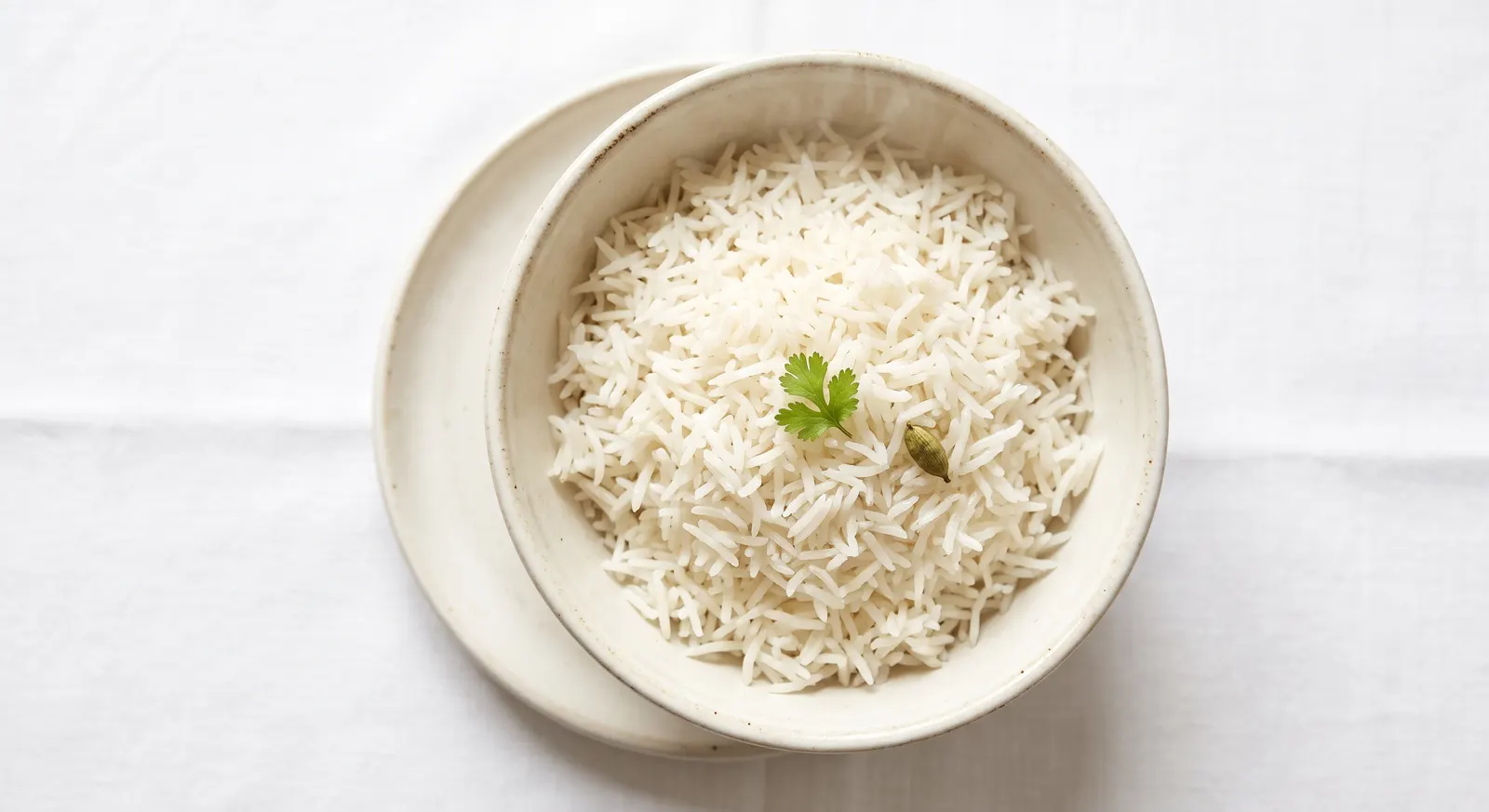
- Prep
- 35 min
- Cook
- 22 min
- Total
- 57 min
- Serves
- 4
- Heat
- Not spicy
What Steamed Basmati Rice is
Plain basmati is the base almost every curry is eaten with, and the whole job is keeping the grains distinct. Every step in the method exists to stop the grains sticking together. Cooked right it smells faintly of popcorn and the grains double in length rather than width.
Where it comes from
Basmati is grown in the Himalayan foothills of India, Pakistan and Nepal, and is aged deliberately — a year or more in storage dries the grain so it absorbs water without swelling sideways. That ageing is why a bag of new-season rice cooks stickier than an aged one, and why good basmati costs what it does. The same grain is also sold raw-milled, parboiled and steamed, and each behaves differently in the pot: parboiled sella grains are harder, take more water and resist breaking, which is why restaurant kitchens use them for biryani and for rice that has to hold through a service.
How to eat it
Rice is the plate, not a side. Spoon curry onto the portion of rice you are eating now and leave the rest dry — flooding the whole plate at the start makes the last mouthfuls cold and soggy. Eaten by hand, you use the fingertips of the right hand to mix a small amount with the curry and press it into a loose ball. If the curry is thin, press a hollow into the centre of the mound and spoon the gravy into that, which holds it instead of running to the rim.
Goes well with
- Any curry with gravy
- Dal
- Plain yoghurt and pickle
How it varies
Rice is the most regional thing on an Indian table, and plain rice means something different in each state. In the north it is basmati, aged and long; in Bengal it is gobindobhog, a small sticky grain that goes into pulao and payesh; in Kerala it is matta, red and parboiled; in Tamil Nadu it is ponni, usually boiled rather than raw-milled; and in Karnataka and Tamil Nadu seeraga samba is kept for biryani. The method splits three ways. Absorption, as here, is the method for everyday rice. The draining method boils the rice in a large pot of salted water and pours it off while the centre is still firm, which gives very separate grains and is standard for biryani and in restaurant kitchens. A rice cooker does the absorption job with a thermostat, and its keep-warm setting will dry the base after an hour. Brown basmati keeps its bran, so it takes about ten minutes longer and a little more water. The finger method — water to the first joint of the index finger above the rice — is how many homes measure without a jug, though it is less reliable in a wide pan, where the same depth holds far more water than in a narrow one.
After the meal
Cold rice goes hard because of starch retrogradation: as it cools, the gelatinised starch re-crystallises and the grains set into a firm, glassy mass. This is reversible only partly, and only with water and heat together. Sprinkle a tablespoon of water per portion over the rice, cover, and heat in a microwave for ninety seconds at medium power, then leave it to stand for a minute; or steam it for five minutes; or put it in a covered pan over low heat with a splash of water in the base. Dry heat — an oven, a dry pan, a microwave without water — drives more moisture out and makes it chewier. Cooked rice also needs care: cool it within an hour, keep it covered in the fridge, and eat it within a day, because spores that survive cooking can multiply in warm rice. Reheat only once, until it is steaming hot throughout. Frozen in flat portions it keeps a month and reheats well. What does not survive is the basmati aroma, which is volatile and gone within a day, so day-old rice is best fried — with egg, or as lemon rice with peanuts and curry leaves.
Ingredients
- 300 g Basmati rice
- 450 ml Water — A 1:1.5 ratio by volume after soaking.
- 1 tsp Salt
- 1 tsp Ghee or oil — Optional; helps the grains stay separate.
- 2 pods Green cardamom — Optional aromatic.
- 1 Bay leaf — Optional aromatic.
How to cook it
1Rinse until the water runs clear
Rinse the rice in several changes of cold water, swirling with your fingers, until the cloudiness is gone. That cloud is loose surface starch and it is what glues grains together in the pot.
2Soak for thirty minutes
Cover with cold water and leave for thirty minutes, then drain well. Soaked grain hydrates from the outside in at an even rate, so it cooks through without the outside turning to paste first.
3Bring to a boil once, then drop the heat
Combine the drained rice, measured water, salt, ghee and aromatics. Bring to a boil uncovered, then immediately cover and reduce to the lowest heat.
4Leave it alone for twelve minutes
Do not lift the lid and do not stir. Every look releases the steam that is doing the cooking, and stirring breaks grains and releases starch.
5Rest off the heat for ten minutes
Take the pan off the heat, still covered, and leave it. The residual steam finishes the grains at the top and firms up the ones at the base.
6Fluff with a fork, not a spoon
Lift and separate gently with a fork. A spoon presses and compacts; a fork lifts. Remove the cardamom and bay before serving.
Calories and nutrition
Per serving — 1 bowl, cooked (about 180 g)
| Calories | 240 kcal |
|---|---|
| Protein | 5 g |
| Carbohydrate | 50 g |
| Fat | 2 g |
| Fibre | 1 g |
| Sodium | 390 mg |
Approximate values for a typical restaurant portion, calculated from standard ingredient tables. Actual figures vary with the kitchen, the oil used and the portion served. Not intended as medical or dietary advice.