South Indian food
Rice, lentils and fermentation — a lighter, sourer tradition with almost no relation to a North Indian menu.
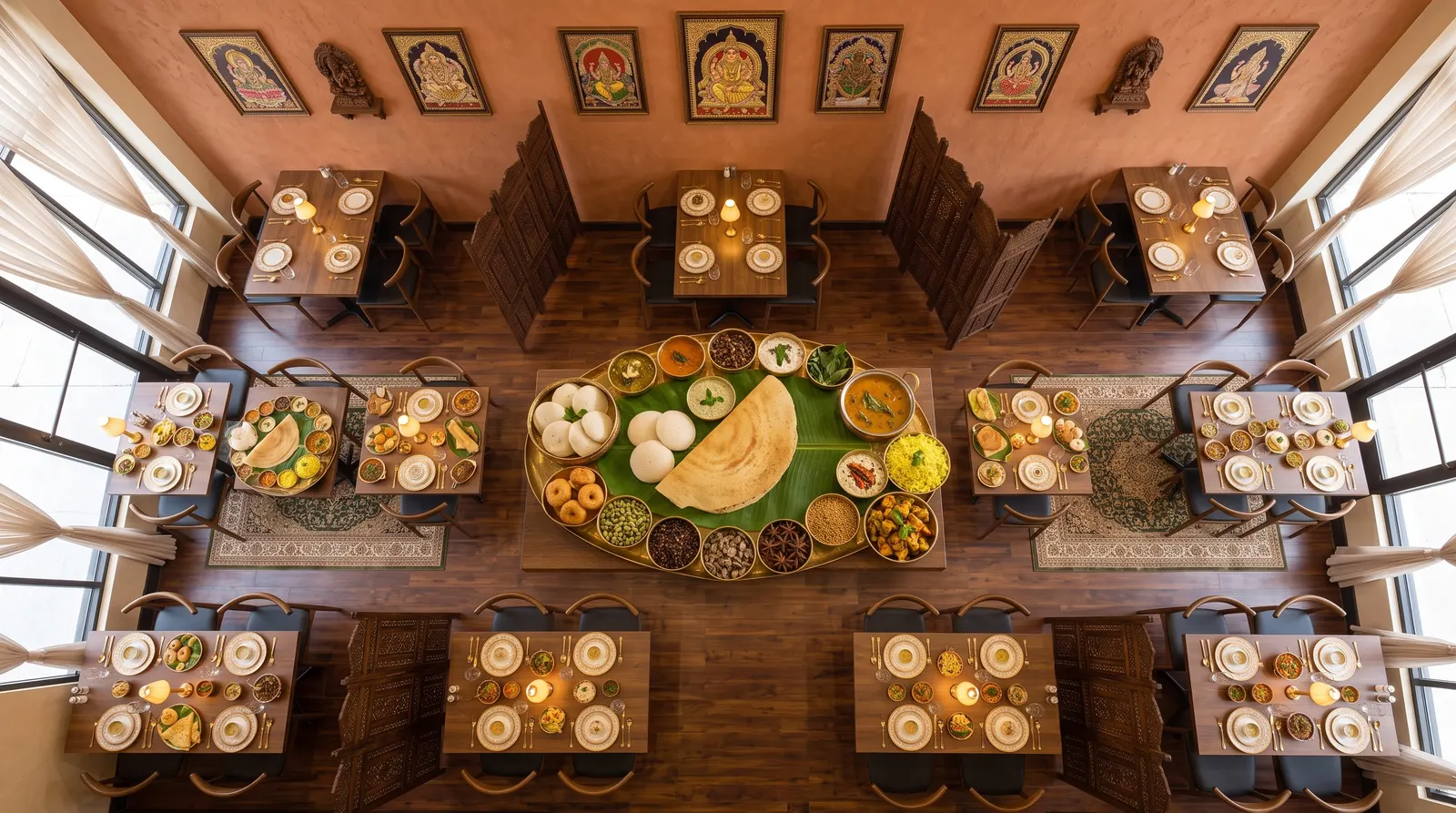
What South Indian food is
South Indian cooking is built on rice and lentils rather than wheat and dairy, and on fermentation rather than slow-browned onion. Dosa, idli and vada all start from a batter left to ferment overnight. Coconut, curry leaf, mustard seed and tamarind do the work that cream and garam masala do further north, and the result is lighter, sharper and often vegetarian by default. Restaurant menus abroad compress it further, into dosa, idli, vada and a thali, which is the Udupi repertoire rather than the whole region.
What defines it
Fermentation and tempering. A dosa batter of rice and urad dal is left overnight, and the sourness that develops is the flavour — a same-day batter makes a pancake, not a dosa. Then tempering: mustard seeds popped in hot oil with curry leaves and dried chilli, poured over at the end. Both techniques are about transformation rather than richness, which is why the food can be eaten daily in a way a butter chicken cannot. The batter is the technical spine of the whole menu. The same rice-and-lentil mix becomes idli when steamed, dosa when spread thin on a hot plate, uttapam when poured thick and studded with onion, and paniyaram when poured into a mould. The grind, the ratio and the fermentation time are what a kitchen is judged on, which is why a dense, flat idli tells you more about a South Indian restaurant than anything on the curry list.
How a meal works
Breakfast is a real meal here and much of the menu belongs to it — idli, dosa and vada are morning food in South India, whatever time a restaurant abroad serves them. A full meal is the thali: rice in the centre, many small portions around it, eaten with the right hand in a set order. Everything is poured onto the rice rather than eaten separately. In a home the meal is rice, sambar, a vegetable poriyal, rasam and curd in that rough order. The sequence matters: the palate moves from sour and hot to cool and mild, and the curd rice at the end is there to settle it. A sadhya, the Kerala feast, spreads the same idea over a banana leaf in a fixed layout, with salt, pickles and banana chips along the top edge of the leaf.
What it tastes like
Sour, hot and coconut-rich, with a tempering of whole spices on top. The sourness is the signature and it comes from three places: tamarind in sambar and rasam, fermented batter in dosa and idli, and yogurt in the cooling dishes. Heat comes from dried red chilli and from black pepper — pepper is the older heat source and remains the point in Kerala and Chettinad cooking, where it is used as a flavour and not only as a burn. Fat is coconut oil, sesame oil or ghee, and coconut appears in three forms: grated, ground into a paste with chilli and curry leaf, and as milk in Kerala. The tempering of mustard seed, urad dal, curry leaf and dried chilli is goes on at the end, so a sambar smells sweet and sharp before it tastes sour. Sweetness is used as a contrast, in jaggery in rasam and in the payasam at the end. The overall balance is rice as the neutral base, one sour dish, one hot dish and one coconut dish, with something crisp to break the texture.
Where it comes from
South Indian cooking grew out of rice, monsoon rivers and a long coastline. The Kaveri delta and the coastal plains produce rice two or three times a year, and the cuisine is built around it: rice as the meal, rice ground into batter, rice flour for puttu and appam. The temple towns of Tamil Nadu, Karnataka and Andhra developed a public kitchen tradition — the large temple feeding halls, the cooking without onion or garlic, the prasadam — that still shapes what a thali looks like. The Chettinad region, home to a trading community with links across the Bay of Bengal, developed a dark, pepper-heavy cooking with its own masala, and its dishes now stand for 'spicy south Indian' abroad. Kerala's coast was the pepper trade: the Malabar coast supplied black pepper to Arab, Chinese and later European traders for centuries, and the communities that grew around that trade — Syrian Christian and Mappila Muslim — cook beef and fish, and pork in the Christian households, in ways that surprise anyone expecting South India to be vegetarian. The Portuguese brought the chilli and the cashew, and the British built Madras into a city with clubs, hotels and a coffee habit. What travelled abroad, though, was largely the Udupi restaurant tradition — temple-derived, vegetarian, cheap, run by cooks from coastal Karnataka.
If it is your first time
A masala dosa is the right first order and is close to unimprovable. Eat it with your hands, tearing pieces and dipping them into the sambar and chutneys rather than cutting it with cutlery. If you want the fuller experience, order a thali and work from the mildest bowl outwards. Filter coffee at the end is not optional as far as most South Indians are concerned. Order a plain dosa before the masala one if you want to taste the batter, since the potato filling covers it; a ghee dosa costs more and is worth it. In a thali, eat the rice with the sambar first, add the vegetable to the same rice; rasam is a drink as much as a soup, and is often poured over a last small mound of rice rather than eaten at the start.
Worth knowing when you order
- Dosa is eaten with the hands, torn and dipped
- Andhra on the sign means genuinely hot; Kerala means coconut
- Filter coffee, not chai, to finish
Dishes to know
Regional variation
Tamil, Kerala, Andhra and Karnataka cooking differ sharply and a restaurant rarely says which it is doing. Andhra food is the hottest by a distance, and also the sourest. Kerala uses coconut most heavily, and its sadhya is a vegetarian feast although its everyday food is not. Tamil cooking is what most South Indian restaurants abroad approximate. Chettinad, from Tamil Nadu, is the exception. Karnataka has its own split: Udupi cooking is vegetarian, coastal Mangalorean cooking is fish and coconut. Telangana cooking around Hyderabad is heavier, meat-based and closer to the Deccan than to the coast.