Nepali food
Lighter, sourer and less oily than its neighbours, built around a tray of rice, lentils and greens.
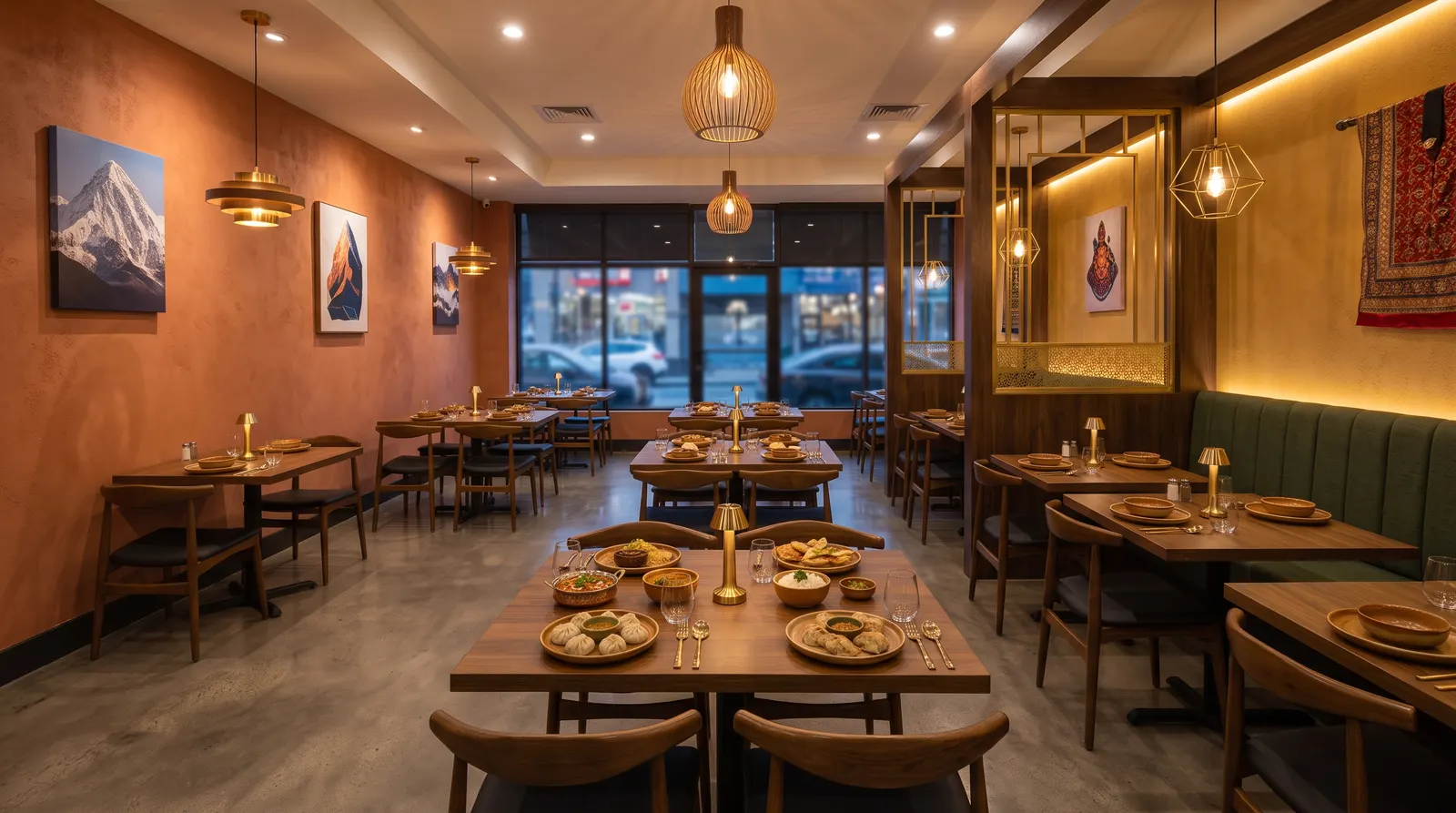
What Nepali food is
Nepali food is quieter than Indian food. Less cream, less oil, and heat that arrives as a sharp pickle on the side rather than being cooked through the dish. The everyday meal is dal bhat — rice, thin lentil soup, a vegetable and pickle — eaten twice a day by most of the country, and the restaurant menu is essentially that plus momo. The range behind the menu is wider than the menu shows: what travels is the everyday food, not the festival cooking or the court cooking of the Kathmandu Valley.
What defines it
Two ingredients mark it out. Timur, a Himalayan relative of Sichuan pepper, gives the tingling numbness in momo achar. Jimbu, a dried allium herb from the high hills, is what makes Nepali dal smell unmistakably unlike Indian dal. Beyond those, the technique is restraint: gravies are thinner, dairy is rare. Dal is thin and often sour, vegetables are stir-fried with turmeric and chilli or boiled and dressed, and meat is curried with little more than onion, ginger, garlic, turmeric and timur. Fermentation is the other marker: gundruk and sinki are made by wilting greens or radish leaves, packing them tightly and leaving them to sour, and the same jar is then used as a vegetable, a soup and a souring agent in the same kitchen.
How a meal works
Dal bhat is served on a divided steel tray and eaten with the right hand: pour some dal over part of the rice, mix it there, eat that, then pour more. The rice never sits sodden. Refills of rice, dal and vegetable are traditionally unlimited and offered without being asked for, so take a modest first serving. The pickle is a condiment measured in smears, not spoonfuls. The order of eating is roughly fixed: a little dal on the rice, a piece of pickle, a mouthful of vegetable, then more rice. Some households start with the bitter or the pickle to wake the appetite and finish with buttermilk or the starchy water the rice was cooked in. A guest is served first and pressed to take more; the host will refill without asking, and the ordinary courtesy is to eat until you are full and then leave a small amount on the tray to show that you have had enough.
What it tastes like
Nepali food is sourer and leaner than Indian food, and the sourness is fermented rather than citrus. Gundruk and sinki give a deep, savoury sourness to dal and to vegetable dishes; achar adds lime, tamarind or tomato; yogurt is used, but less than in the north of India. Fat is mustard oil, ghee or the fat from the meat. Heat comes as fresh green chilli, chopped into a pickle or served whole on the side, and as timur, whose tingle is numbing rather than burning. Jimbu, used in a pinch and fried in ghee, gives dal a smell somewhere between hay and onion. The overall balance is salt and sour against rice, with heat as an adjustment rather than a baseline. Restaurant versions push the oil up and the sourness down, which is why a good dal bhat abroad often tastes flatter than it should.
Where it comes from
Nepal is a country of altitude bands, and its cooking is really three or four cuisines stacked on top of one another. The Terai, the northern edge of the Gangetic plain, grows rice and pulses and eats close to Bihar; the mid-hills, where most of the population lives, grow rice in terraces and millet and maize on the slopes, and keep buffalo, goats and chickens; above the tree line there is barley, buckwheat and yak, and the food turns Tibetan. The Kathmandu Valley is a fourth case. The Newar cities of Kathmandu, Patan and Bhaktapur ran the trade between India and Tibet for centuries, and their cooking — buffalo, beaten rice, fermented greens, a ritual repertoire of dozens of dishes — reflects a wealthy urban culture rather than a subsistence one. Nepal was never colonised, and the food kept a household and courtly grammar rather than the restaurant grammar that Mughal and then British India developed; there is no cream-and-nut gravy tradition of the same weight. What changed the food's reach was migration. Gurkha service, labour migration to India and the Gulf, and a diaspora that opened restaurants in Japan, Britain, Australia and the United States carried dal bhat out as the everyday meal and momo out as the snack that sells.
If it is your first time
Momo and dal bhat, in that order. Momo tell you whether the kitchen can cook; dal bhat tells you what Nepal actually eats. If jhol momo is on the menu — momo served sitting in a thin spiced broth — order that instead of the steamed ones. Gundruk will taste strange and sour the first time, and is worth ordering anyway. If there is sekuwa, skewered and grilled meat, order it too: it is the closest thing Nepal has to a barbecue and it is usually good. Ask for achar on the side rather than assuming the heat is in the dish, and if the menu offers a set with refills, take it, because it is the best value on the list.
Worth knowing when you order
- Ask for jhol momo if it is on the menu
- Gundruk and other fermented greens are the local flavour, not a novelty
- Buff momo is the Kathmandu default; chicken is the gentler introduction
- A dal bhat set is a better first order than a curry and rice
Dishes to know
Regional variation
The Kathmandu Valley's Newar cuisine is its own tradition, with a repertoire most restaurants abroad never attempt. In the high hills the food shifts towards Tibet — thukpa, tsampa, butter tea — and in the Terai lowlands towards Bihar, with more rice, more vegetables, lighter spicing and less fermentation than the hills. Buffalo is the everyday red meat in Kathmandu, and buff momo is what most momo shops there actually sell. The eastern hills, where many Gurkha families come from, cook with more fermented greens; the far west leans on buckwheat and millet, and on dried vegetables for the months when nothing green is growing.